
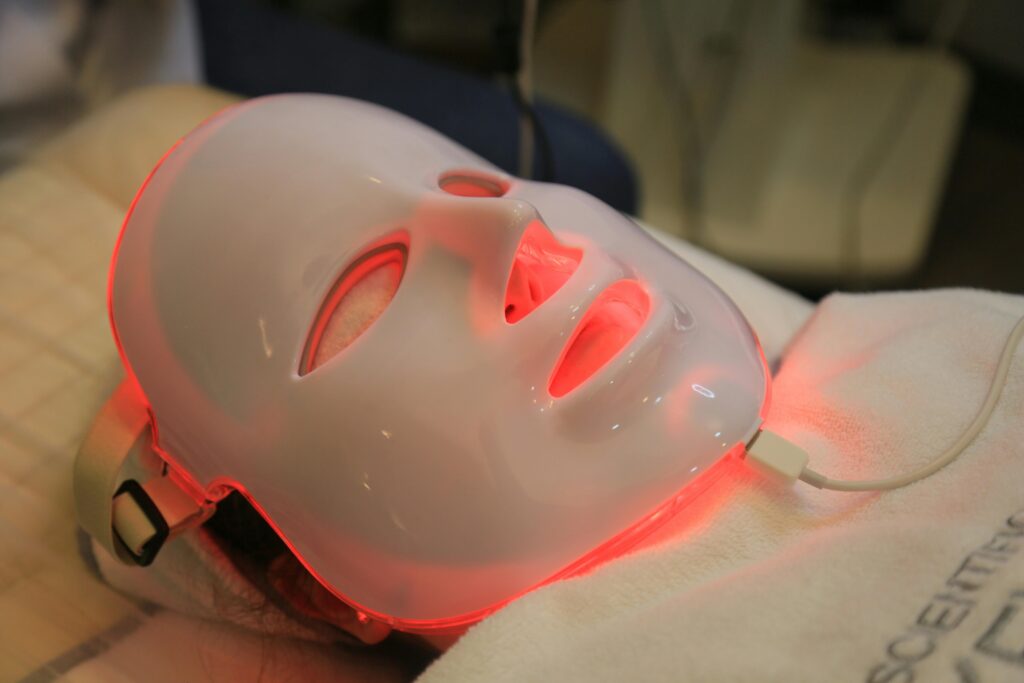
This is currently one of my favorite topics. Conversation on red light therapy seems to have grown significantly in the past few years; without a doubt, the most common question that I hear – “Does it really work?” Put simply, YES.
If you don’t believe me or need more convincing, or you just really want to read my babbling (I’m flattered), let’s take a look at the research.
Red light therapy has been a known tool, primarily for the skin and cosmetic purposes. However, recent studies have found that muscular pain and inflammation, including chronic neck pain, and various ocular (eye) diseases can be treated using red light therapy. In fact, a 2025 study revealed that for individuals with chronic neck pain, red light therapy can relieve pain symptoms, gradually improve neck mobility and restore function with continued use (Jiang et al. 2025).
But how does this work?? I’m going to break this down and in doing so, we’re going to have to tap into that locked away memory of high school biology. Bear with me here.
Remember the powerhouse of a cell? That’s called mitochondria. Its basic function is to provide energy for cells; this energy is in the form of adenosine triphosphate (ATP). So the more ATP that a cell has, the greater its ability to perform cellular processes. Some of these processes include muscle recovery, nerve signaling, and tissue repair.
Now looking at red light and near-infrared light, these contain very long wavelengths. This means that the light can penetrate through surfaces like skin, muscle tissue, etc. The wavelength of red light ranges around 660+ nanometers, and the wavelength of near-infrared light ranges around 800+ nanometers. This means that red light can easily go through the skin barrier, but near-infrared light can go even deeper; think muscle tissue, nerves, etc. So, we’ve established that red light can reach deep into our tissues, but what does it do once it gets there?
Stick with me, we’re getting there!!
When red light and near-infrared light penetrate the skin barrier, it targets mitochondria. Now each mitochondria contains a specific protein (cytochrome c oxidase, or CCO) that helps it make more energy, or ATP. This protein is also what absorbs all of that red light. Once the red light is absorbed by the protein, the mitochondria itself gets excited. SO excited, that it essentially kick-starts the activity of making more ATP. What this means: red light gets absorbed by protein in the mitochondria = kick start energy production = lots and lots of ATP! Now remember, the more ATP, the better our cells can work toward muscle recovery, tissue repair, etc. Red light can help your body speed up those processes.
Recent studies have supported this whole idea; for example, a 2025 narrative review on eye care suggests that red light therapy helps recharge aging or damaged retinal cells because of the retina’s high mitochondrial density (Xue et al. 2025). Another narrative review looking at red light for pain control in the most common musculoskeletal conditions claims that in cases of knee pain, osteoarthritis, post-operative hip pain, fibromyalgia, and temporomandibular disorders, red light therapy has been found to help reduce pain (Oliveira et al. 2021).

I’ve been using red light for about one year now and I’ve noticed great effects on my vision, skin health, and muscle recovery. If you’re interested in purchasing a medical-grade red light device, pay attention to the wavelength – 660+ nm will promote the cellular process that I touched on! I use the brand Joovv, specifically the Joovv Go 2.0. Now these can be quite pricey, but I truly cannot recommend red light enough. If you have experience with red light or decide to start your journey today, I’d love to hear about it! I hope this information answered some questions, provided knowledge, and inspired you to take control of your health journey.
More info, including the articles sited in this post: Efficacy of a wearable 660 nm red light therapy device in alleviating neck pain and enhancing neck function | Lasers in Medical Science | Springer Nature Link, Illuminating eye care: the promise and future of red light therapy in ophthalmology | Graefe’s Archive for Clinical and Experimental Ophthalmology | Springer Nature Link, Low-intensity LASER and LED (photobiomodulation therapy) for pain control of the most common musculoskeletal conditions – PMC.